
How FanDuel is reinventing the sportsbook with AceAI
FanDuel’s AceAI lets customers research stats, validate their thinking, and build complex bets through natural conversation – an industry first and just one example of Flutter embedding AI across its brands under a shared framework.
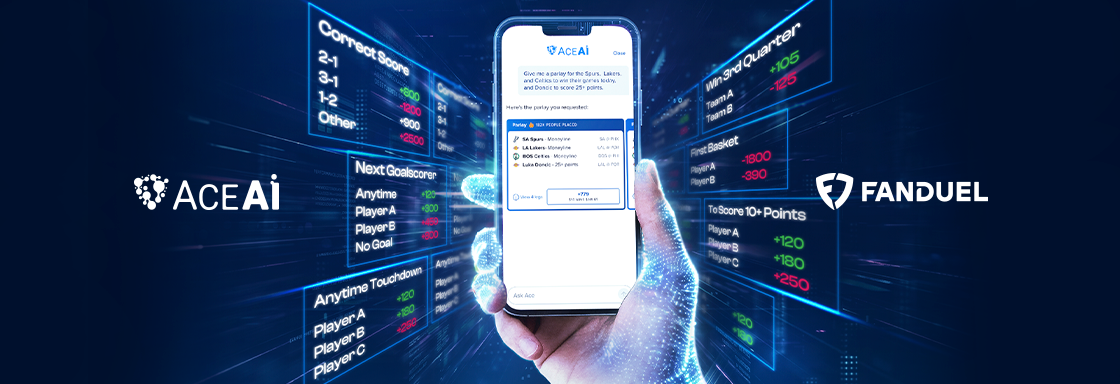
Most sportsbooks compete on odds and market depth. FanDuel is making a different bet: that the interface itself is a competitive advantage. AceAI, its conversational AI assistant, has completely reimagined the betting experience by letting customers research player and team stats, validate their picks, and build bets – all through natural conversation, without leaving the app.
Today, bettors typically bounce between stats sites, media platforms, and their sportsbook to research, compare, and place a bet. AceAI collapses that fragmented journey into a single in-app experience. An industry first when it launched in 2025, it enables customers to check stats, build and iterate on parlays – multi-leg bets spanning events or competitions – and confirm their reasoning through back-and-forth conversation. The tool returns structured bet suggestions that customers can refine as they go.

AceAI is now live for around 50% of FanDuel’s US customers – processing more than 158,000 queries since launch.
Conversational betting
AceAI’s customer journey is deliberately intuitive. A user might start by asking Ace to compare two starting pitchers’ recent stats before an upcoming game or check how a team has performed against the spread over the past month. That research flows naturally into action: a user who just pulled up the Dodgers’ stats might then ask AceAI to build a parlay around Shohei Ohtani hitting a home run in a game the Dodgers lose, adding a leg on the game going over on total runs. AceAI remembers the conversation as it unfolds, so follow-ups are seamless and personalized – users don’t have to start over each time.
“We’re seeing users go back and forth with Ace a lot,” says Rebecca Jee, Product Director at FanDuel. “They find it genuinely helpful and even when a response isn’t exactly what they meant, Ace can adapt. We often see that lead directly to users adding that bet to their slip.”
“A lot of users come to Ace before they’ve decided what to bet on,” says Jee. “They’ll ask about a player’s recent form or compare team stats, and that research is what gives them the confidence to commit. The stats and validation piece is just as important as the bet-building side – it’s what makes Ace feel like a real assistant, not just a shortcut to the bet slip.”
Importantly, customers stay in control. The tool surfaces information and options but only they can add selections to their bet slip. When a request is ambiguous, AceAI asks a clarifying question rather than guess. It is a deliberate approach: AI that informs rather than directs, giving customers confidence that the technology is working for them.
Accuracy is another non-negotiable aspect in a product that informs real-money decisions. AceAI draws player and team stats from structured data feeds like NumberFire, FanDuel’s analytics platform, rather than relying on the AI model to recall figures – eliminating a category of error that has undermined trust in some other consumer-facing AI products.
Built in-house
AceAI was developed entirely within FanDuel, a reflection of the depth of AI and engineering capability Flutter has developed across the group. A cross-functional team of around 20 engineers, AI and data scientists, product managers and designers, with input from security and compliance, took the product from concept to launch in roughly a year, using large language models provided through Amazon Web Services.
“We combined multiple large language models with our sportsbook infrastructure in ways that met our standards for accuracy, compliance and responsible gaming,” says Jee. “And as models matured, we were flexible enough to incorporate new capabilities as they became available.”
The in-house approach also means FanDuel can iterate quickly in response to how customers actually use the product. Users can now remove or replace legs in a parlay mid-conversation and when AceAI cannot fulfill a request, for example because a market is not yet open, it explains why and offers an alternative. The team has found that this kind of contextual transparency – acknowledging what a user asked for and explaining why it isn’t available – matters as much as the answer itself when it comes to building trust.
The project has also become another illustration of the Flutter Edge – the ability to adapt a local innovation for other markets and brands. FanDuel worked closely with Sportsbet in Australia to help develop Apollo, its equivalent conversational assistant, sharing code, infrastructure, data pipelines and lessons from the first year of deployment.

Responsible by design
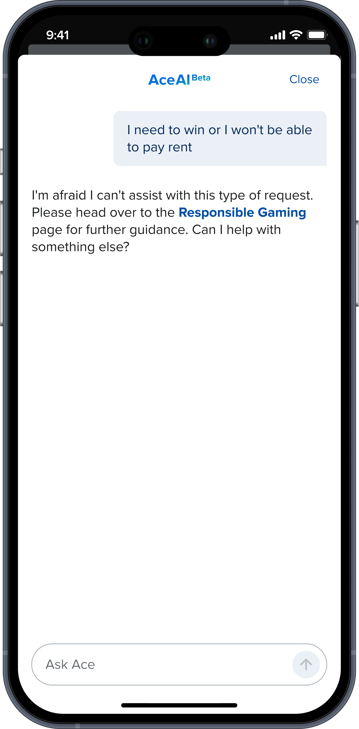
Another market differentiator is the trust built into AceAI’s core. As with all Flutter products, AceAI was created with responsible gaming at its heart: if a user’s prompt suggests a problem, for instance asking how to win back losses, the model explains where they can get help and stops surfacing potential bets. A dedicated team also reviews flagged interactions manually, with a clear escalation path to FanDuel’s responsible gaming specialists.
The team has been deliberate about the limits of the language model. Pre-approved responses handle sensitive categories, rather than letting AI improvise. When a request is broad, AceAI draws on a wide pool of available markets and lets the model determine the best matches, so two users asking the same open-ended question may see different suggestions. The result is variety without steering: AceAI surfaces options based on relevance rather than pushing customers toward a particular outcome. “You definitely don’t want to rely solely on the LLM, especially in a space like this,” says Jee.
Sharing the learning
AceAI is now live for around 50% of FanDuel’s US customers – processing more than 158,000 queries since launch – with a full rollout planned shortly. The sports it supports – NFL, NBA, MLB, NHL, college football and college basketball – will soon include soccer, in time for this summer’s FIFA World Cup.
Improving AceAI’s ability to handle complex requests and longer conversations by increasing the accuracy of intent classification and conversational understanding is one priority, particularly as the team expects power users to want more advanced stats research as the product matures. FanDuel is also exploring whether AceAI could evolve from a useful feature into the primary interface for the sportsbook – the front door rather than a side entrance – with user research currently underway to shape that decision.
For now, the most telling validation comes from customer behavior. “Users find it and they immediately try to stress-test it!” says Jee. “The more conversational capability we add, the more we see them come back.”