
How the bracket became a billion-dollar business
A paper tradition born in a Staten Island bar turned into one of the biggest betting events on the American sports calendar.


It started in a bar in Staten Island
The idea for a bracket pool did not begin in a boardroom or a Vegas sportsbook. One of its earliest recorded origins dates to 1977, at an Irish pub called Jody’s Club Forest in Staten Island, where 88 regulars each put in $10 to predict the final teams. Nobody won. That was rather the point.
Bracket pools spread through offices and neighborhoods through the 1970s and ‘80s. The format has barely changed: you pick a winner for every game, watch your predictions unravel thanks to upsets and underdogs, and convince yourself you'll go further next year. Unlike most professional sports, where loyalty tends to be city-specific, this tournament draws in alumni and communities from every corner of the country. Almost everyone has a team, and almost everyone thinks they know more than most about the latest superstar or dark-horse team coming through the ranks.
The probability of a perfect bracket sits at 1 in 9.2 quintillion. In more than 80 years of the tournament, no one has ever managed it. The closest known attempt correctly predicted the first 49 games before falling apart in round 16. The near-impossibility of the bracket is, paradoxically, the thing that makes it irresistible.
Building something better than a bracket
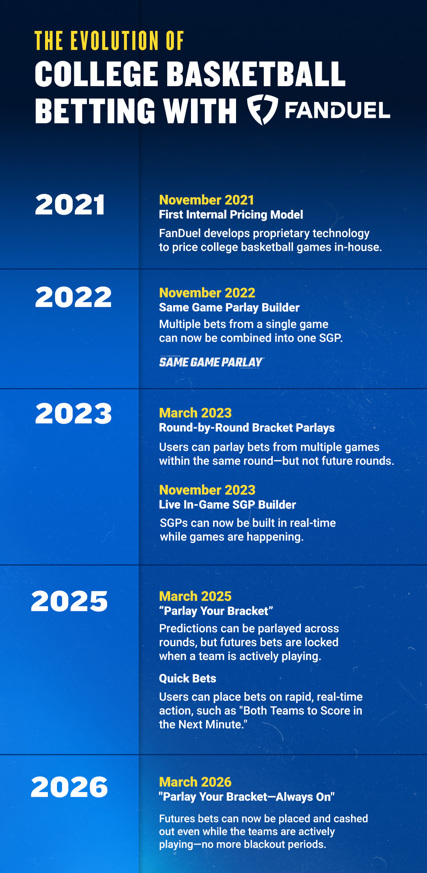
In 2021, FanDuel built a proprietary NCAA Basketball trading model from the ground up. What emerged was one of the most sophisticated real-time sports betting operations in the country. Today, the operation delivers comprehensive pricing across 67 games with depth, precision and accuracy that sets the standard in college sports betting.
The core insight was straightforward: the bracket captures something real about how fans want to engage with the tournament. The thrill is in picking specific outcomes, not predicting everything. So FanDuel built a product that mirrors that instinct.
“A lot of that office pool nature, how people want to interact with the tournament generally, is what drove us to cater to that in our product,” said Joe Caputo, Trading Manager at FanDuel. “We really want to give customers the ability to parlay as many elements of their own bracket as they can.”
A single tournament game now comes with around 40 to 50 betting markets, from the final score to individual player performance. Same Game Parlays, live betting, and futures markets sit alongside a redesigned interface with new grid views that show every team’s odds to advance through each round in one place. Lines move every second during play.
The operation behind it all
Putting that product live, across 67 games, in real time, takes a trading operation that has grown roughly five times since 2021. FanDuel’s team now spans more than 130 colleagues across North America, Australia, and Europe, with three traders assigned to each game. Speed matters at every level.
“Back in the day, it would take us an hour or two to get everything on the site,” said Price. “This year, we’ll have everything pre-created, so once we plug in the bracket, we could have everything up within minutes.”
Back in Jersey City, the screens are still flickering and the traders are not looking up. College basketball is the fifth most popular sport to bet on with FanDuel customers; remarkable for an amateur sport competing for attention with professional leagues such as the NBA, NFL, MLB and global tennis. Not bad for something that started with 88 people and a $10 entry fee.