
United by the Game: Inside Flutter's global operation to power the world’s biggest betting moment


At a glance
- This is the biggest World Cup ever for FIFA, with Flutter’s soccer pricing powering bets for its customers globally, across all its brands simultaneously.
- H2 Gambling Capital (H2GC) expects $60bn in legal sportsbook wagering globally, while Flutter anticipates double the total stakes of the 2022 World Cup in Qatar.
- The tournament is expected to be the biggest customer acquisition event in Flutter’s history, with millions of first-time bettors entering the regulated market.
The 2026 FIFA World Cup kicks off in Mexico City on June 11, with 48 teams, 104 matches and three host nations. It will be the biggest betting event in history, with up to $60bn in legal wagering expected worldwide. Flutter alone expects around 10m customers across its brands to place bets, with total stakes expected to double those of the previous World Cup in 2022. At peak demand globally, Flutter expects that it will manage 100,000 bets per minute – much higher than this year’s Super Bowl.
It’s also a live test of Flutter’s global capabilities – and the world’s largest sports betting and gaming company by revenue is mobilizing to meet the moment. For most major sporting events, Flutter's trading operation uses a follow-the-sun model, with regional teams assuming operational responsibility as markets move across time zones. The World Cup is different.
Throughout the tournament, operating teams in Dublin and Melbourne will work side-by-side, managing matches live as a single global function. By operating concurrently rather than through a series of handovers, Flutter can bring together trading expertise from across the business, ensuring greater collaboration, continuity and consistency throughout the tournament. “We’ve really become a global enterprise, delivering global experiences at pace, in a way only Flutter can,” says Alan Clarke, Flutter’s Chief Product and Trading Officer.


One team, one tournament
“This is a defining moment in Flutter’s history,” says Karen Lockwood, Flutter’s UK and Ireland (UKI) Football Director. With a global team of 100 traders from Dublin to Melbourne, we compile soccer pricing for key brands FanDuel, Sisal, Snai, Sportsbet, Paddy Power, Betfair and Betnacional.
With matches across four time zones, traders will work concurrently for the first time, around the clock so a rush of money on Harry Kane in London sharpens his odds for a punter in Sydney. “It’s not about what division of Flutter you’re working for,” Lockwood says. “It’s about the game itself.”
To prepare, Flutter worked fast to get newer brands on to the Group’s main risk and trading platform. Italy’s Snai went live in early May, giving its customers the deeper in-play markets and a new suite of World Cup products that other Flutter brands already enjoy. Brazil’s Betnacional, acquired last year, also recently moved into customer testing on the platform. “The preparation for the World Cup started with this key workstream nearly a year ago in Brazil,” Clarke says.
-
100 Flutter colleagues researching 48 nations.
-
50,000+ player markets built in-house.
-
100,000 bets per minute at peak globally.
Modeling the unknown
Pricing a 48-team tournament is different from pricing, for example, the Premier League. International squads play together infrequently, so there’s less data available. And the expanded format brings in nations that Flutter hasn’t priced before, from Curaçao to Cape Verde.
To bridge that gap, Flutter ran an internal mock World Cup draw, where traders from around the world were assigned a team and their players to research and price. Several stepped forward and asked to work on specific teams based on their own personal heritage or bespoke local knowledge, with the collective findings feeding into the 50,000-plus unique player markets being compiled in-house.
The pricing challenges for the team are at the edges – minnows whose form and players are unknown, and the final group games where qualified teams could rest star players. Malachy Rooney, Flutter’s UKI Head of Football Strategy and Pricing, pointed to the opening match of the 2022 tournament, when host nation Qatar were widely expected to be competitive at home but were beaten 2-0 by Ecuador. “The entire market got Qatar wrong. It quickly became apparent that they were completely out of sorts.”
Rule changes need pricing in, too. FIFA’s yellow-card amnesty between group and knockout stages, for example, reduces jeopardy for players, which Flutter expects to increase card counts.
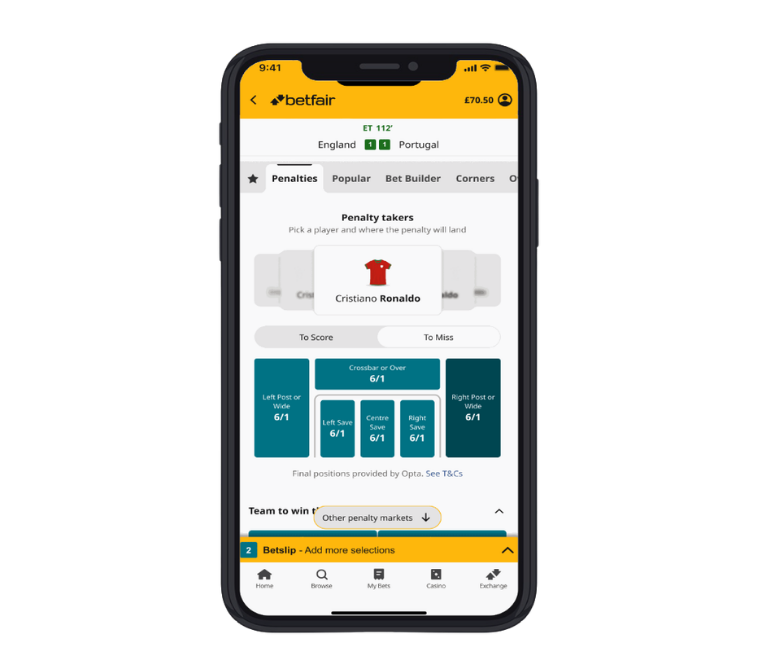
There are also new products, such as a penalty shootout experience which lets customers bet on where in the goal a penalty will be placed, priced across six sections of the net. Having gone live just in time for the Champions League Final, which Arsenal lost to PSG on penalties, the new product will come into play in the knockout rounds, and Flutter believes it is a first of its kind. The question, Rooney says, was how best to price the product: chase data on every individual taker, or start from the macro pattern of where penalties tend to be scored and layer in the players who reliably favor one corner.
“Models are only as good as their inputs,” Rooney says. “An AI element helps us sift through the noise, but subject-matter expertise is what gets a model from 97% pricing accuracy to 100%, which is what we’re striving for.”
Winning the summer
For FanDuel, already the largest U.S. sportsbook by market share, the World Cup is the clearest test yet of whether the Flutter Edge – the ability to leverage a global view for local markets and brands – can extend that lead through the summer. It is also an opportunity to bring first-time soccer bettors into a regulated product. “For all the time the U.S. has been live, this is the clearest example yet of the Flutter Edge in action,” says Joseph Cundall, Commercial Director at FanDuel. “There’s been a real collaborative effort to produce a compelling proposition for U.S. soccer fans, whether they are new to the sport given the World Cup or already interested in it.”
Cundall’s team set two goals for the tournament: drive sustained volume into the second half of 2026 and amplify the FanDuel brand. A U.S. customer-insight program identified pain points. Many U.S. sportsbook users are less familiar with soccer; traditional settlement rules may be less intuitive; soccer is not as prominent as other sports on the site; and the sport itself can feel flat compared to their regular U.S. sports, where there is rarely a draw. “How can something finish 0-0 and not go to overtime?” was a typical refrain.
The answer was three new product launches for FanDuel customers. The first, 120-minute markets, addresses FanDuel’s top U.S. customer complaint. “Our number one customer reaction was: why is my wager settled as a loser when they won in extra time?” Cundall says. From the knockout stages, if a match goes into extra time, the bet will now pay out the full 120-minute match, rather than counting only the first 90 minutes.
The second, Super Sub, is repositioned for the U.S. as a fairness play; in Europe it is a surprise-and-delight protection against a substitution, which was first implemented by Flutter’s Italian brand, Sisal, and quickly replicated for its UKI brands. If the player you’ve bet on goes off, the bet transfers to his replacement. “We think it’s even more powerful in the U.S., given this whole narrative around fairness,” Cundall says.
The third, Quick Bets, lets customers wager on individual players in short in-play windows: Erling Haaland to score in the next 10 minutes, Jude Bellingham to be booked. Quick Bets is more granular than typical game-level versions, more akin to the possession-based bets that are popular in U.S. sports like NBA or NFL.


Why regulation wins
The World Cup will be watched by billions. For Flutter, it is also the most visible opportunity yet to demonstrate what regulated operators do that black market ones cannot, and why that distinction matters for customers and markets alike.
The illegal gambling market is a growing threat. In the UK, the black market could be worth £33bn by 2028; in the Netherlands, illegal operators now account for more than half of all gambling revenue. In Brazil, Flutter's own research suggests between 30% and 50% of spend still runs through unlicensed operators, even after legalization. The UNODC warns that during the World Cup, illegal betting volumes could outweigh regulated ones globally.
The World Cup gives Flutter a global stage to prove that regulated operators don't just comply – they compete and win on quality, safety, and trust. While Flutter tailors customer safeguards to local regulations wherever it operates, its core customer safety principles are the same – to lead progress and promote positive play. Flutter aims to proactively monitor play across its platforms, detecting certain unusual patterns and giving customers reassurance that safeguards are in place.
“Customer safety is fundamental to our overarching strategy across all brands,” says Andrew Branigan, Sports Director at Paddy Power, while John Carroll, CCO of Flutter Brazil, casts it as a matter of trust: bet with a licensed, listed operator and you can have confidence that “your details are safer, your funds will be processed legally and your withdrawals processed quickly,” which is “what you put at risk betting in the black market.”
A foundation for the future
Beneath the new products and pricing models is an engine handling 1.5bn daily price changes. “It’ll be a fantastic testament to our technology platforms: 100,000 bets per minute globally are expected at peak – more than we’ve seen at any other event,” Clarke says.
The capability building is just as deliberate. The Global Trading team seeks to share best practice with operational trading staff around the globe. For instance, two Dublin traders spent weeks in Melbourne and similarly other brands have done likewise, with Australian traders spending time in Dublin with their UK and Irish-based colleagues. The goal is to standardize the Group’s best practice and ensure the capability built outlives the tournament.
For all the trading machinery, the prize Flutter is really playing for is customers, with generosity built into all local campaigns – such as payouts for FanDuel customers for every goal scored – designed to build lasting loyalty. “This is the springboard for the next phase of growth,” says Branigan. “Regardless of match results, we can control how we show up, how many customers we can attract and the reach of our propositions.”

This blog contains “forward-looking statements” within the meaning of the Private Securities Litigation Reform Act of 1995. Such forward-looking statements are subject to various risks and uncertainties, and actual outcomes or results may differ materially from those indicated in these statements. Words such as“believe(s)”,expect(s)”, “potential”, “continue(s)”, “may”, “will”, “should”, “could”, “would”, “seek(s)”, “plan(s)”, “estimate(s)”, “anticipates”, “projection”, “aspire” and comparable words are intended to identify “forward-looking statements”. Factors that could cause results to differ materially from those described in the forward-looking statements can be found in Flutter’s Annual Report on Form 10-K and other periodic filings with the SEC, which are accessible on the SEC’s website.