
How Flutter's tech leaders are putting AI to work
Most companies are already experimenting with AI. Few are using it at scale.

A new 2026 State of AI in Gaming report from UNLV's International Gaming Institute and KPMG found the industry's average AI maturity sits at just 45 out of 100, despite more than 80 percent of operators already using some form of generative AI. Closing that gap, between adoption and real operational advantage, was a recurring theme at this year’s TechConnect event.
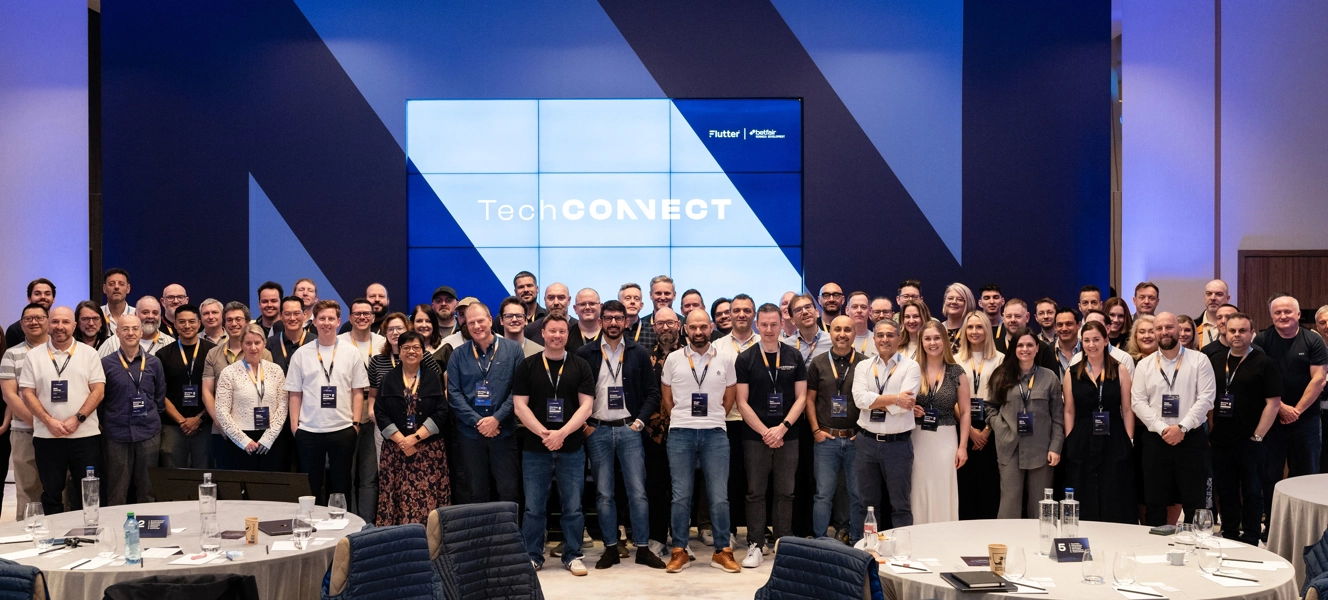
TechConnect started last year as a global gathering designed to connect 65 tech leaders in Cluj, Romania, and more than 7,000 technologists online across Flutter’s brands and time zones. This year, AI took center stage.
For Conor Lynch, Flutter's Chief Information Officer, that means looking past the hype to where the impact actually lands. "What we have to do is look at how we can enhance the way in which we work, how it can increase our productivity, how it can make us more effective in delivering and building the products and operating our products, and actually securing our business as well," he says. "It's got a massive role to play, and it's something that we should just face into head on."
That's the spirit behind what follows: with first-hand experience of AI's operational impact across the business, here's what's in front of mind for Flutter's tech leaders.
1. The data advantage
Every operator has access to the same AI models. What they do not have is the same data.
Karl Wintrell, Chief Technology Officer for Global Platforms, points to Flutter's scale as the real advantage. “As the largest global betting and gaming operator, we have access to an incredible amount of data," he says.
Used well, that data can sharpen decisions on pricing and risk and has the potential to strengthen both responsible gambling and commercial outcomes. Wintrell also flags financial services and e-commerce as sectors well advanced in applying AI to customer decisions, as examples to learn from. The wider data backs this: the same 2026 State of AI in Gaming benchmark cited above found gambling operators are "more closely aligned with regulated financial services" than retail or media in how they prioritize AI, with data infrastructure across the sector still in its earliest stage, the exact gap Wintrell says Flutter's data set closes.


2. Personalization, down to one
It's a highly competitive industry, and the detail of customer experience is what sets brands apart. Karl Wood, Director of Technology at tombola expects the next shift in customer expectations to be granular. "Personalization will go down to the level of an individual rather than a cohort," he says, "and I think that will be the main change." tombola is already using generative AI to assist with game design and animation work, which has quietly improved product quality for customers.
He cites Spotify and Amazon as companies worth watching, not for direct comparison, but for how openly they have built AI into their engineering culture, including code written by AI itself. One caveat matters in a regulated industry, he adds, "tombola's approach is to make changes responsibly, not just to hit an endpoint faster."
3. Flipping the fraud math
JJ Agha, CISO and Enterprise Software SVP at FanDuel, frames AI's security impact. “We know that attackers are also using these AI models, and we're using it too," he says. "It helps even the playing field for us." Within FanDuel, and Flutter more broadly, customers are already benefiting from better fraud and security protection working in the background.
"I'd look at the payments industry," he says. "They've been using AI constantly, heavy in fraud, heavy in bot protection." It's a sector that has spent years hardening itself against exactly this kind of AI-enabled attack, and one Agha sees as the clearest benchmark for where betting and gaming needs to go.


4. Real-time player protection
Mike Foster, CIO at Sportsbet, points to real-time player protection as one AI use case already live across two Flutter brands, with AI models helping to identify and flag behavioral signals that may indicate a need for additional support. The tool is called Real-Time Intervention (RTI) at Sportsbet (launched in 2022) and Real-Time Check-In (RTCI) at FanDuel (launched 2025, adapted from Sportsbet’s models), and it flags outlier deposit behavior, enabling customer service agents to prompt customers in the moment to reflect.
Jurisdictions like New Jersey are moving to encourage exactly this kind of real-time monitoring. RTI predates that shift by four years, which shows Flutter's brands are often early movers in developing player protection tools, ahead of formal regulatory frameworks.
Foster also flags where the bar moves next: retail brands are letting customers engage through AI agents rather than an app, and he believes that this has the potential to be applied to betting and gaming. His five-year view: "You could have us building a whole new app in real time, tailored right to what the customer wants to bet on," something no business can do today, but a real possibility.
5. AI as a thinking partner
For Tony Stokes, Group Director of Enterprise Technology, the most immediate impact of AI is on Flutter's own people. "People have AI as a thinking partner to help with their day-to-day work, whether in finance, marketing or tech," he says. "It's like a daily tutor for our people, it's helping to make our people more effective."
Stokes doesn't pretend the shift is comfortable. Rethinking how people work, rather than just speeding up what they already do, is "a little bit unnerving" for some, he admits, which is why Flutter is leaning into training and support rather than assuming the change explains itself.


6. Growing AI capability
For Sara Sousa, General Manager at Blip, Flutter's sports betting center of excellence in Porto, the starting point isn't the tool, it's the people using it. "AI is here to supercharge our engineering teams," she says. "It takes on repetitive tasks, it helps us write and review code faster, and it gives teams more time to focus on the hard problems: design, logic, and product value."
That focus on people over hype shapes how Blip is rolling AI out. The hub's goals are to maximize AI tool usage, track real efficiency gains, and partner with Flutter's brands to help define the future of product engineering, all built on the belief that "the best ideas start from within."
The practical expression of that is "earn your license": the idea that a tool is only as powerful as your ability to use it well. The AI Hub, an internal learning platform with paths from basic to advanced topics, launched with its first modules already live, built by Blip's own trainers. That upskilling showed up at the hub’s first Leap AI Day this year, a flagship event combining a keynote, real project stories and hands-on workshops, which teams put into practice in a competition focused on building working AI-powered solutions.
"This is the momentum we want to keep building," Sousa says, "not on slides, but in real work, real products, and real people."
AI is not one bet Flutter is making, it's dozens of smaller ones: in fraud prevention, in personalization, in player protection, in customer experience, and in how colleagues work day to day. Every operator has access to AI. The advantage comes from how fast Flutter learns, shares, and scales what works, the magic behind the Flutter Edge.